

Let me be direct with you: when the press release landed Thursday morning, I sat with it for a full minute before I wrote a single word. (And then I opened a new release from the brewery.)
Rohrbach Brewing Company — Rochester’s first craft brewery, the place that essentially educated this city on craft beer since it opened in 1991 — is under new ownership. The brewery is transitioning to a group led by Joel Will, a nearly two-decade company veteran who will serve as President & COO, and his brother Nathan Will, who steps in as CEO. Founders John Urlaub and Patty Yahn-Urlaub, who built Rohrbach from a basement operation into the cornerstone of western New York’s craft beer economy, are stepping back.
That’s the news. Now here’s why it matters — and why, despite the seismic nature of it, this transition feels less like a rupture than a logical conclusion.
Joel Will is not some outside investor who discovered craft beer during the pandemic. He is, in the most meaningful sense, Rohrbach’s. He started at the Buffalo Road brewpub, worked his way up over nearly two decades, shaped the company’s operational culture, and — in one of those biographical details that tells you everything about a person’s relationship to a place — met his wife, Jessica, there. He has been running day-to-day operations across both locations after returning to the fold in the last year or so. (Will thought the grass would be greener on the other side, took a job in a different industry in the area, and realized beer is where he feels most at home. Lucky for us.) In many ways, Thursday’s announcement makes official what has functionally already been true. (That’s not a knock on the process — it’s the highest possible compliment to both Urlaub’s mentorship and Will’s quiet competence.)
“After 35 years of business, Rohrbach’s has become a special place for many in the Rochester community,” Will said Thursday in a press release. “I met my wife while working here, formed countless friendships, and found a passion for craft beer. I am beyond grateful to John and Patty for the years of mentorship that have led to this moment, and for the trust that they have placed in Nathan and me to carry on what they have built.”
That’s not boilerplate. (Though it did come from a release. Unsurprisingly, it’s a very well-written release. Urlaub and Rohrbach have never taken shortcuts. I plan to sit down with Joel and John in the very near future to talk about how this came about.) That’s a person who grew up inside an institution talking about what it means to carry it forward.
Nathan Will brings more than three decades of executive experience in international energy, finance, and real estate — the kind of operational infrastructure expertise a multi-location, 85-plus-employee brewery genuinely needs to scale thoughtfully. (Craft beer is romantic. Cash flow management is not.) Together, the Will brothers represent exactly the kind of succession founders spend years hoping for and rarely find: internal continuity backed by external capability.
Urlaub was characteristically measured. “In the life cycle of every business, there comes a time to transition to a new generation of leaders like Joel and his leadership team, who can take the business to the next level. There’s not a better scenario for this transition.”
How we got here
To understand why this moment carries the weight it does, you need to know where Rohrbach started — and how deliberately it traveled to get here.
Urlaub launched the brewery in 1991 in the basement of the German House in Rochester’s South Wedge neighborhood — a building with the kind of Old World bones that felt almost predestined to house a brewery. From the beginning, the philosophy was intentional restraint. “We never really grew 100 percent in a year, and that’s intentional. It’s always been steady,” Urlaub told me in 2016. “My goal was never to be big.”
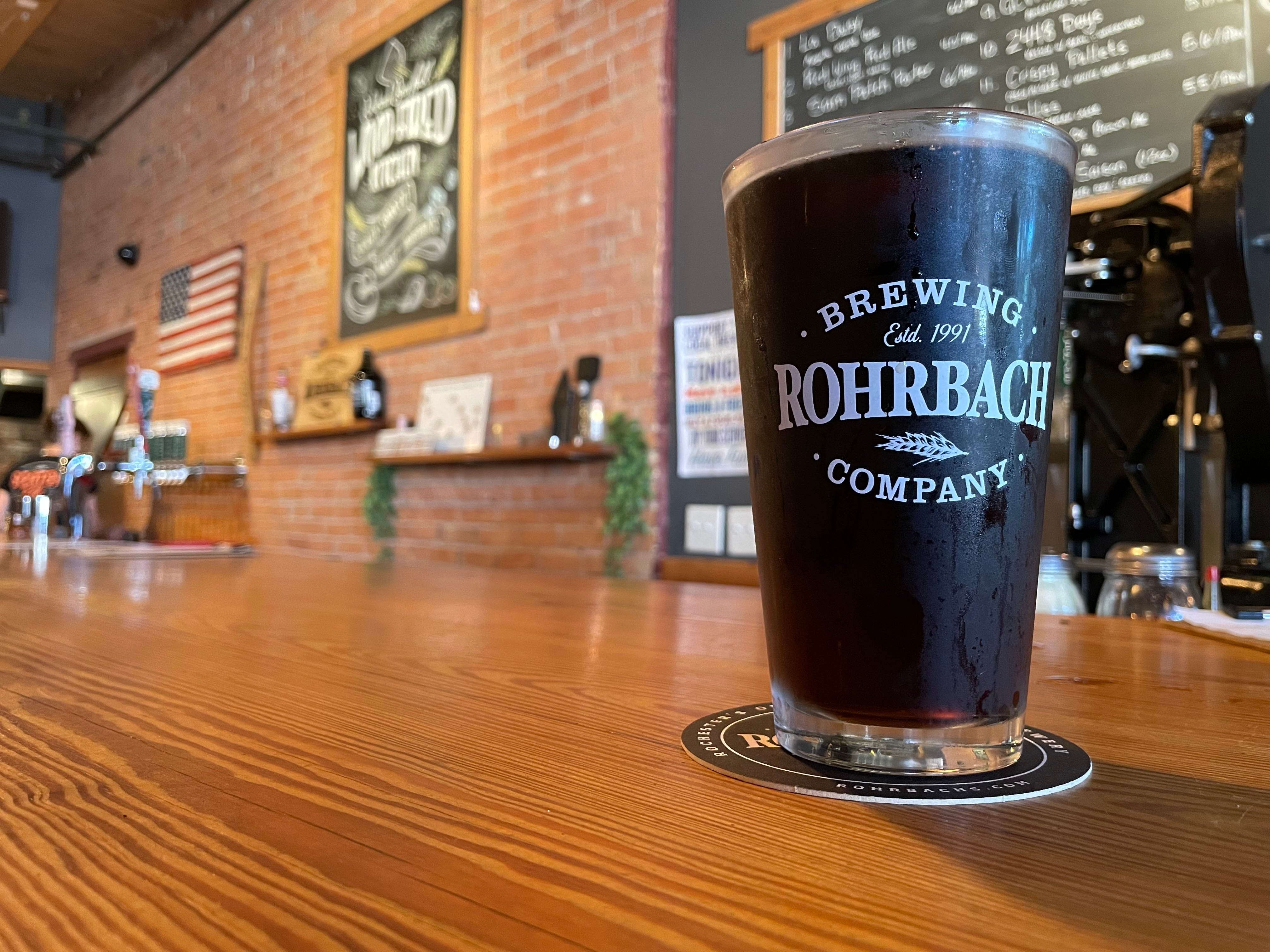
That steadiness shaped everything. By 1994, Rohrbach (through pioneering head brewer Dave Schlosser, who later founded Naked Dove Brewing in Canandaigua) had produced the Scotch Ale — malt-forward, deeply satisfying, and destined to become one of the most beloved beers in the region. (It’s wild that the Rohrbach Scotch Ale, along with the Genesee Cream Ale, became the most well-known and well-regarded craft beer in the Rochester region.) In an era when the craft conversation was dominated by hoppy beers, the Scotch Ale was a quiet statement of purpose: we know what we’re doing, we’re not chasing trends, and we’ll be here when you come back. For many Rochester drinkers, it was their first real craft beer — the pint that recalibrated their expectations for what beer could actually taste like.
In 1995, the Buffalo Road brewpub opened in Ogden — the location that would, for a generation of Rochesterians, simply be Rohrbach’s. The South Wedge original closed in 2001, and in 2008 Rohrbach made its boldest move yet: a production brewery on Railroad Street near the Rochester Public Market, right in the city’s Market District. It was a bet on Rochester’s urban core at a moment when that bet wasn’t obviously smart. (It turned out to be very smart. And we can really thank Urlaub for his vision there, because he helped revive an entire city neighborhood.)
The Railroad Street facility grew into something genuinely impressive. Under longtime director of brewing operations Jim McDermott — who himself had a long arc with Rohrbach, left for North American Breweries, and came back — the brewery expanded capacity by 30 percent, adding fermentation space and cold storage to a facility capable of producing up to 10,000 barrels. (It has expanded capacity a few times since then and taken over the neighboring part of the building that was formerly home to Black Button Distilling. That section of the building is now an event space, home to a shiny, new canning line, and barrels.) Rohrbach got here by doing three core things: buying more tanks, keeping the beer fresh, not cutting corners.
Rohrbach started canning its flagship beers in 2014. (Raise your hand if you remember the “Growler Era,” when you could buy fresh Rohrbach beer from Wegmans and then return the growlers to be refilled.) The Beer Hall opened at Railroad Street in 2016. (When I profiled the brewery in 2016 for the D&C, Rohrbach had 60 employees. Ten years later, it has 85 employees. Slow, calculated, measured growth.) And through its smaller-batch Neoteric series, the brewery gave its brewers room to experiment — which is how Space Kitty happened.
The double IPA, created by Buffalo Road head brewer Zach Porrey, debuted as part of the Neoteric series and became a cult favorite almost immediately. It celebrated its tenth anniversary last year. (Ten years of Space Kitty. Think about that.) The fact that a brewery best known for a Scotch Ale could also produce a DIPA with that kind of following says everything about how Rohrbach grew without ever abandoning what made it great. As Urlaub put it to me a decade ago: “Quality will determine the future. If we’re making good beer, that will always be a solid industry.”
He was right then. He’s still right.
The Young Lion footnote — for now
As I reported here in January, Rohrbach had already quietly acquired Young Lion Brewing from K2 Brothers Brewing before Thursday’s ownership news — picking up the brand’s recipes, trademarks, and tap handles after a complicated chain of transactions that saw the beloved Canandaigua brewery drift through several owners without ever losing its reputation. Young Lion co-founder Jen Newman told me at the time that landing with Rohrbach meant the brand would be “respected, protected, and allowed to grow.” Joel Will cited the fit plainly: “Approachable. At Rohrbach, we’ve always focused on approachable beers.”
That deal made sense on its own terms. Now, with the full ownership picture clear, it makes even more sense. Young Lion isn’t a distraction or a side project — it’s an early signal of what the Will brothers’ stewardship might look like: deliberate, values-aligned, and rooted in the same corner of New York where they grew up.
What it all means
I’ve covered this brewery and this community for years, across two publications. I’ve watched Rohrbach navigate the explosion of the regional craft scene, the pandemic, and every trend cycle that came and went while the Scotch Ale just kept being the Scotch Ale. (And don’t forget about the brewery’s other flagships like the Highland Lager, Blueberry Ale, and Vanilla Porter.) That kind of durability isn’t accidental. It comes from culture, and culture comes from people who actually care about the place.
Urlaub built that culture over 35 years, starting in a South Wedge basement with no interest in global domination — just enough brand equity to sell beer in and around Monroe County. “We didn’t get out of the Rochester market for a long time,” he told me in 2016. “All the growth we wanted was right here.”
Now that culture belongs to the Will brothers, who grew up down the road in Brockport. The brewery stays local, stays independent, and stays in hands that understand what it means.
Rohrbach acquires Young Lion brand, keeping a Finger Lakes favorite alive

Young Lion Brewing is getting a new home — and, maybe more importantly, a fresh chance to stick around.
Rohrbach has been apart of my entire adult life. When I moved back to Rochester in 2001 we would visit the brewpub often. Any major milestone we got kegs from them. No deposit on barrels and taps, just a handshake and trust.
For my 30th birthday we grabbed 2 barrels, one highland lager, one scotch ale. John let me borrow a jockey box with CO2 and buckets for the kegs which was the classy move over just taps and barrels.
I still remember what he said as we loaded up the truck “Scotch ale, bold choice for a summer party”
He was right, 4 generations of family and friends ended up staying the night after a few too many. 😂
I love this move by them and wish John and Patty a wonderful and well deserved break.
Wow. To my knowledge, this is the first such handoff in Western New York craft brewery history. I do have a fairly complete set of Rohrbach growlers. I vaguely remember seeing Red Wing Red Ale in a growler years ago; I do not have one of those, though I do have an Octoberfest growler.